
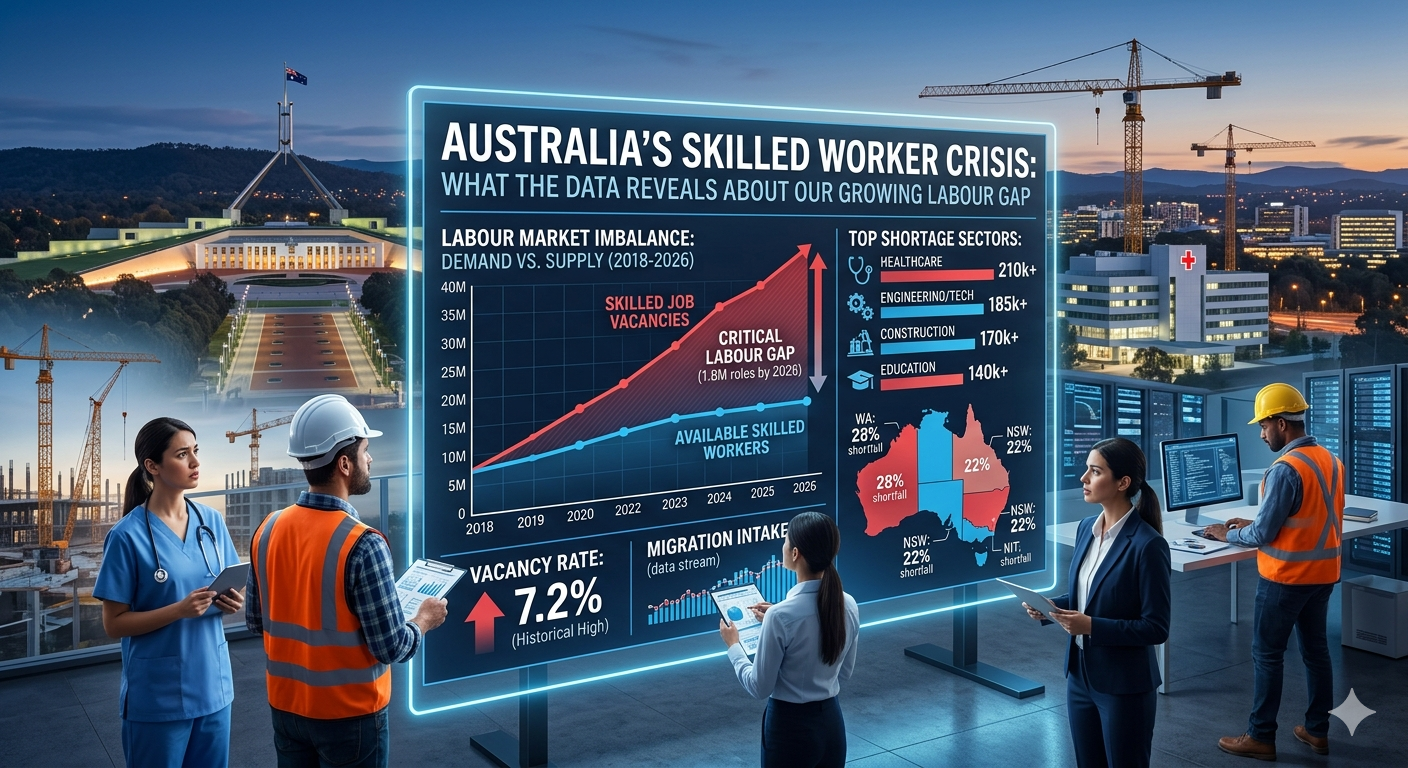
Skills Shortage Overview
Australia is grappling with one of the most significant workforce challenges in its modern economic history. Across virtually every major industry, employers are struggling to fill critical roles — and the evidence increasingly suggests that this is not a temporary post-pandemic disruption but a deep structural deficit that will shape the decade ahead. According to Jobs and Skills Australia’s (JSA) 2024 Skills Priority List, 332 occupations were assessed for national shortage status. Of those, approximately 286 — representing 86 per cent — were found to be in shortage (strong or moderate). That means in nearly nine out of every ten skilled roles assessed by the federal government’s own labour market intelligence body, the supply of qualified workers is failing to meet employer demand.
86% of occupations assessed by Jobs and Skills Australia in 2024 were classified as being in shortage — spanning trades, healthcare, care services, technology, and food production.
The Australian Bureau of Statistics (ABS) provides further context. As at February 2024, Australia recorded approximately 338,500 job vacancies. While this represents a decline from the pandemic peak of 480,000 vacancies in mid-2022, it remains more than double the pre-pandemic norm of roughly 150,000. Crucially, many of these vacancies are concentrated in highly skilled, hard-to-replace roles — the kinds where you cannot simply hire anyone willing to work and expect quality outcomes.
The Structural Forces Behind the Crisis
Three converging long-term forces have produced Australia’s current skills environment, and understanding them is essential for any employer developing a credible workforce strategy.
Demographic shift is the most powerful. Australia’s population is ageing rapidly. The ABS projects that by 2030, one in five Australians will be aged 65 or older. The baby boomer generation — which anchored the skilled workforce for four decades — is now in peak retirement phase. As these workers exit, they take with them not just headcount but decades of tacit knowledge that cannot be quickly or cheaply rebuilt.
Vocational training underinvestment has compounded the problem significantly. According to the National Centre for Vocational Education Research (NCVER), apprenticeship and traineeship commencements fell by more than 20 per cent between 2015 and 2020. Although successive governments have introduced incentive schemes, the pipeline of trade-qualified and vocationally skilled graduates has never fully recovered. Completion rates for apprenticeships in construction trades, for example, sit at approximately 50 per cent — meaning one in two people who begin a trade qualification never reach the finish line.
Australia’s apprenticeship completion rate is approximately 50% — meaning half of those who start a trade qualification never finish it. (NCVER, 2023)
The COVID-19 pandemic inflicted a further structural wound on Australia’s labour market by dramatically suppressing net overseas migration between 2020 and 2022. During those two years, Australia lost an estimated 500,000 potential skilled migrants who would normally have supplemented domestic pipelines in healthcare, construction, and care services. The subsequent rebound — with net migration reaching a record 518,000 in 2022–23 — has eased some pressures in hospitality and retail but has done comparatively little to fill the deep shortfalls in highly regulated professions like nursing, aged care, and engineering.
The Sectors Feeling the Sharpest Pain
No industry has been immune, but the most acute pressures are being felt in sectors that share two characteristics: high qualification thresholds and significant workforce churn. These include:
- Aged and disability care — facing both rapid demand growth from an ageing population and systemic wage and career status challenges that fuel annual turnover rates above 25%
- Healthcare and nursing — where regulatory requirements and long study pathways mean supply cannot respond quickly to demand signals; ANMAC projects a shortage of 123,000 registered nurses by 2030
- Construction and civil engineering — where Australia’s $230-billion-plus infrastructure pipeline is chasing a dramatically constrained trade workforce
- Information technology — where global demand for software engineers, cybersecurity specialists, and data scientists has turned hiring into a worldwide competition with no geographic borders
- Early childhood education and care — where national qualification mandates have tightened supply precisely as demand from working families surges following childcare subsidy reforms
- Food processing and meat manufacturing — where physically demanding work in remote and regional locations drives annual turnover approaching 40 per cent
The Cost of Under-Responding
Employers who underestimate the severity of the current skills environment risk a cascade of operational and financial harms. Research by Deloitte Access Economics suggests the fully-loaded cost of replacing a mid-level skilled worker — accounting for recruitment fees, vacancy downtime, induction, and the productivity ramp-up time for new starters — typically ranges between 50 and 150 per cent of that worker’s annual salary. For professionally registered roles (registered nurses, engineers, early childhood educators), the upper end of that range is common.
Beyond the direct cost per hire, chronic understaffing generates secondary harms: increased workloads and burnout among remaining staff (which accelerates further departures), service quality deterioration, contract losses, and growing reputational damage in an increasingly transparent labour market where employer reviews on platforms like SEEK and Glassdoor are widely read by candidates comparing their options.
Replacing a mid-level skilled worker costs an estimated 50–150% of their annual salary once recruitment, vacancy downtime, and the new starter’s productivity ramp-up are fully accounted for. (Deloitte Access Economics)
The Path Forward: Multi-Channel Sourcing
Forward-looking Australian employers are responding on multiple fronts simultaneously. Domestically, they are investing in internal pipelines — sponsoring apprenticeships, creating structured career pathways, and partnering with TAFEs and universities to build future talent benches. Internationally, they are exploring migration pathways — particularly the Skills in Demand (subclass 482) visa introduced in December 2023, the Employer Nomination Scheme (subclass 186), and Designated Area Migration Agreements (DAMAs) that create tailored migration pathways for employers in regional Australia or specific industries.
Partnering with a specialist sourcing organisation that understands both the domestic labour market and the complexities of Australian immigration law is increasingly how smart employers are bridging the gap — and doing so without the legal, ethical, and reputational risks that can accompany poorly managed international recruitment. That is precisely the role SkillsNest Pty Ltd was established to fill.
Sources & Further Reading
Jobs and Skills Australia — Skills Priority List 2024 (www.jobsandskills.gov.au)
Australian Bureau of Statistics — Job Vacancies, Australia, February 2024 (Cat. No. 6354.0)
National Centre for Vocational Education Research (NCVER) — Australian Vocational Education and Training Statistics 2023
Deloitte Access Economics — The Real Cost of Employee Turnover (2022 update)
ABS — Population Projections, Australia, 2022 to 2071 (Cat. No. 3222.0)
Department of Home Affairs — Net Overseas Migration Statistics 2022–23