
When a skilled role goes unfilled, most employers see only the most visible cost: the money they are not spending on salary. In reality, the financial burden of a vacancy is far larger, far more diffuse, and far more damaging than a simple line item on a payroll spreadsheet. Understanding the true cost of an empty desk is the first step to building a compelling business case for serious investment in workforce sourcing.
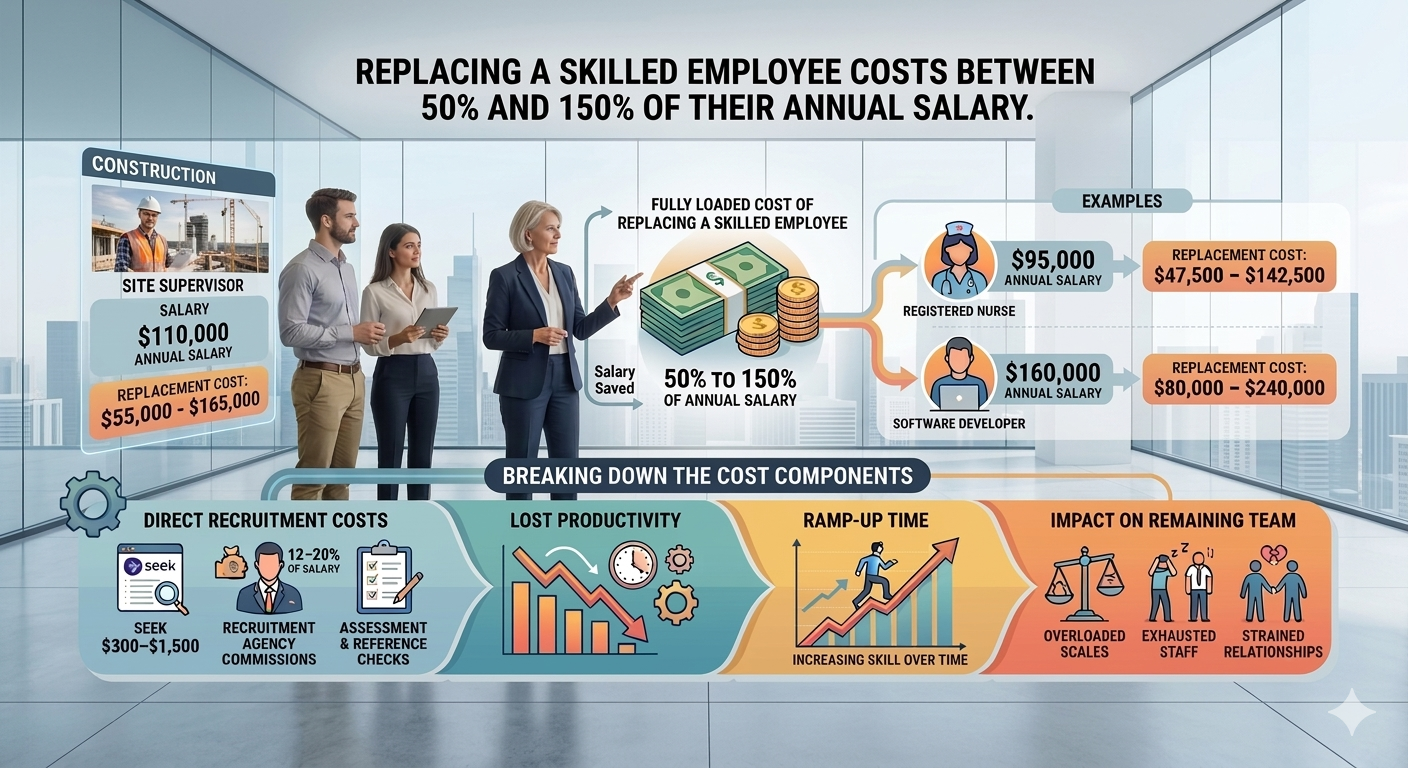
A 2022 analysis by Deloitte Access Economics estimated the fully loaded cost of replacing a skilled employee at between 50 and 150 per cent of that employee’s annual salary. For a registered nurse earning $95,000 per year, that translates to a replacement cost of between $47,500 and $142,500. For a software developer on $130,000, the range is $65,000 to $195,000. Multiply these figures across an organisation carrying five, ten, or twenty vacancies at any given time — which is increasingly common in sectors such as aged care, construction, and IT — and the aggregate cost becomes a material threat to financial performance.
Replacing a skilled employee costs between 50% and 150% of their annual salary, once recruitment, lost productivity, and ramp-up time are fully accounted for. (Deloitte Access Economics, 2022)
Breaking Down the Cost Components
The cost of a vacancy is typically spread across five categories, each of which is routinely underestimated in traditional workforce planning:
Direct recruitment costs are the most visible layer. These include advertising fees on platforms such as SEEK (which can range from $300 to $1,500 per listing depending on the role and visibility level), recruitment agency commissions (typically 12–20 per cent of first-year salary for professional and trade roles), assessment and reference-checking costs, and the staff time consumed in shortlisting, interviewing, and onboarding. For a typical professional hire, these direct costs alone often reach $10,000–$25,000.
Productivity loss during the vacancy period is the second, much larger, component. The ABS reported that as at February 2024, the median time to fill a skilled vacancy in Australia was 7.7 weeks — but in high-demand sectors such as healthcare, construction, and IT, the median extends to 12 weeks or more. During that period, the work that role would have performed either goes undone, is deferred, or is redistributed to existing staff who must absorb it in addition to their own responsibilities.
The median time to fill a skilled vacancy in Australia was 7.7 weeks in early 2024 — but in healthcare, construction, and IT, the typical fill time extends to 12 weeks or more. (ABS, 2024)
Overtime and contractor uplift costs are the third layer. When existing employees absorb a vacant role’s workload, they often accumulate overtime at penalty rates of 150–200 per cent of their ordinary time rate. Alternatively, employers engage labour hire workers or specialist contractors — who typically cost 25–40 per cent more per hour than a directly employed equivalent, with no investment in knowledge or organisational culture. For a role carrying a $90,000 salary, twelve weeks of contractor uplift can easily add $15,000–$20,000 to the vacancy’s cost before a permanent replacement is even found.
Quality and risk costs are harder to quantify but no less real. In regulated sectors — aged care, disability support, healthcare, construction, and early childhood education — an unfilled role is not merely inconvenient. It can directly compromise safety and compliance. When a residential aged care facility is short of care staff, ratios may breach licensing conditions. When a construction project lacks a licensed supervisor, work may need to stop entirely. These operational disruptions can trigger regulatory scrutiny, contract penalties, or reputational damage that dwarfs the direct replacement cost.
The ramp-up productivity loss is the final, often invisible, cost. Even after a new employee is successfully recruited and starts work, most skilled roles involve a productivity ramp-up period during which the new worker performs below the output level of a fully established employee. Research from PwC Australia suggests this ramp-up period typically spans three to six months for technical roles and can extend to nine months for complex professional positions. The productivity shortfall during this period — commonly estimated at 25–50 per cent of full output — represents a real ongoing cost that most workforce planning models ignore entirely.
Breaking Down the Cost Components
When these cost components are aggregated across an organisation carrying chronic vacancies, the financial impact is often startling. A regional aged care provider with fifteen unfilled care worker positions — not an unusual scenario in 2024 — may be carrying an annual hidden cost burden of $1.5 million or more, once overtime, agency fees, lost bed occupancy revenue, and compliance risk are properly accounted for.
Across the economy, the Productivity Commission has estimated that skills mismatches and unfilled vacancies cost Australia tens of billions of dollars annually in foregone output and heightened wage pressure. While this is a macro-level estimate, the mechanism is straightforward: when employers cannot fill roles, they either produce less, serve fewer clients, or pay more per unit of output — all of which reduce both profitability and national productivity.
Australia’s chronic vacancy rate is estimated to cost the economy tens of billions of dollars annually through foregone output, overtime premiums, and productivity gaps. (Productivity Commission)
What Proactive Employers Are Doing Differently
The most financially savvy employers are re-framing the cost of vacancy as an investment calculus. Instead of asking ‘what does sourcing this worker cost?’, they are asking ‘what is the cost of this position remaining unfilled for another twelve weeks?’ When that calculation is done honestly, the economics of investing in specialist sourcing, sponsored migration, or international recruitment almost always look significantly better than the alternative of continued vacancy.
Employers partnering with SkillsNest are accessing a structured, multi-channel sourcing approach that draws on both domestic and international candidate pools — reducing the time-to-fill for hard-to-source roles and minimising the cumulative vacancy cost burden that sits on the balance sheet of every understaffed Australian business.
Sources & Further Reading
- Deloitte Access Economics — The Real Cost of Employee Turnover, 2022
- ABS — Survey of Employee Earnings and Hours, Australia, 2023 (Cat. No. 6306.0)
- ABS — Job Vacancies, Australia, February 2024 (Cat. No. 6354.0)
- Productivity Commission — Review of National Workforce Development Programs, 2023
- SEEK — Recruitment Cost Benchmarks 2024 (seek.com.au/employer)
- PwC Australia — Workforce Productivity and Onboarding Effectiveness Report, 2022